


In 2001, Larry Ellison compared buying enterprise software to buying a car’s parts and hiring someone to assemble them. Twenty-five years later, a business can subscribe to a dozen cloud applications and still employ people to move records, interpret rules, and keep the whole machine running. AI’s biggest commercial opportunity is to sell the working car.
The application has been the product we buy. The work connecting applications has been the customer’s problem. Agents give software companies a chance to take over that work and charge for finishing it. For founders and product managers, this changes what to build, how to price it, and where a business can establish an advantage.
Note: I’ll connect developments across AI, consumer software, and enterprise software to build a thesis about where the software business is heading.
1. The agent becomes the front door
In his 12 October conversation with John Collison, Mark Zuckerberg wondered whether future glasses would even have an app store. Meta has also announced plans to bring its Muse agent to glasses. The ambition is to become the place a person turns to before choosing an application.
I think this shift can matter more than the iPhone. The phone put applications within reach throughout the day. An effective agent can remove much of the work required to operate them. The customer describes a job; the system finds the information and carries it through the necessary tools.
Take collecting an overdue invoice. The work crosses a customer database, a contract, an email thread, and an accounting system. Someone must establish what is owed, follow the collection rules, contact the customer, and reconcile the payment. The company that can coordinate this sequence moves closer to the customer’s reason for buying software.
That puts permissions, approvals, and a record of completed work inside the product. A good interface lets the customer understand a consequential decision and intervene. The opportunity is to spare people from learning every application involved in getting there.
2. Custom software becomes a repeatable business
Software has expanded by removing burdens. IBM separated certain software charges from hardware in 1969. AWS offered pay-as-you-go infrastructure in 2006. AI can lower the cost of adapting those capabilities to a particular company’s work.
A small distributor may need to check stock, apply its purchasing rules, obtain approval, and place an order. It can already buy tools for each step. Commissioning and maintaining the complete process is harder to justify. A supplier that builds reusable connections and learns how to handle the exceptions can spread that engineering across many customers while fitting the process to each one.
That is the commercial appeal of highly customized software: an individual customer receives a tailored process, while the supplier reuses enough of the machinery to earn software margins. If every new account requires another bespoke implementation, the business will keep paying for that labor.
Microsoft reported more than 30 million paid Microsoft 365 Copilot seats in its fiscal fourth-quarter call. Buyers are already paying for assistance. The product opportunity is to earn renewal by taking responsibility for more of the job. Through 2030, I expect the strongest expansion to come from connecting useful capabilities into processes customers can rely on.
3. The bill moves closer to the completed job
Tokens measure a supplier’s model usage. Customers budget for payroll completed, accounts reconciled, orders placed, and support requests resolved. Pricing will increasingly have to connect those two worlds.
Intercom lists Fin from $0.99 per outcome. Salesforce offers action, conversation, and per-user pricing. Microsoft describes seats plus consumption. The market is finding ways to charge for work, with several models operating alongside one another.
For a founder, adding a margin to tokens leaves the hard question unanswered: what does it cost to finish the job? Model calls, retrieval, retries, integrations, support, and human review all belong in that calculation.
Consider an illustrative service charging $60 for a job that costs $35 to deliver. It retains $25 before fixed engineering, sales, and administrative costs. Add $30 of unexpected human intervention and the same job loses $5. A customer can love the result while the supplier loses money providing it.
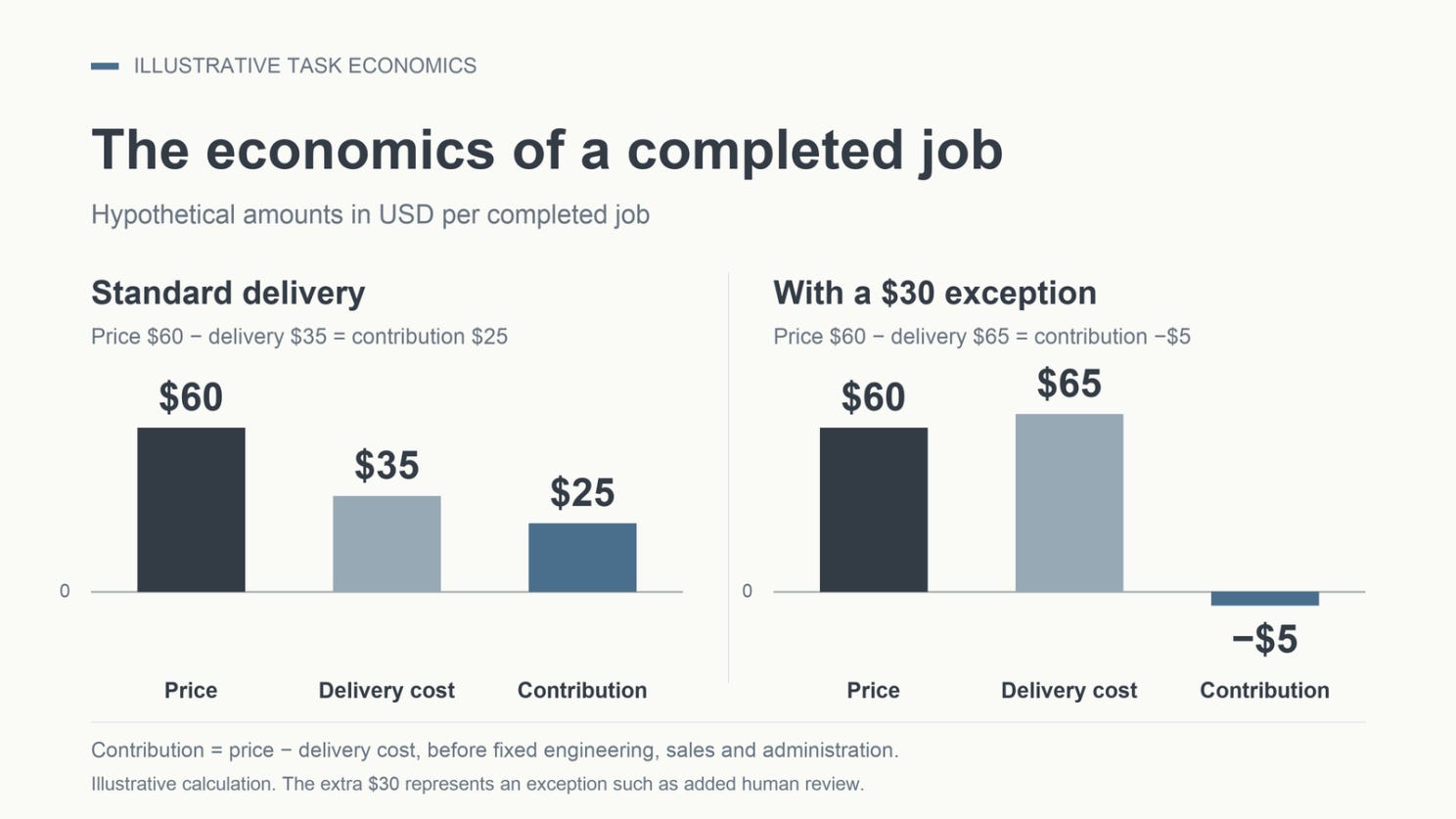
Product teams should measure the cost of a completed task, including difficult cases. Improving the demo is useful and reducing the number of jobs that need expensive rescue can determine whether the company survives.
4. Somebody still pays for the computing
Cheap access to a model can conceal the capital required underneath it. CoreWeave’s quarter ended 30 June 2026 puts the scale of that bill into view: $2.575 billion of revenue, $640 million of net interest expense, and a $626 million GAAP net loss. Net interest expense equalled about 25% of revenue. Its 59% adjusted EBITDA margin excludes depreciation and interest, two major costs in this business.
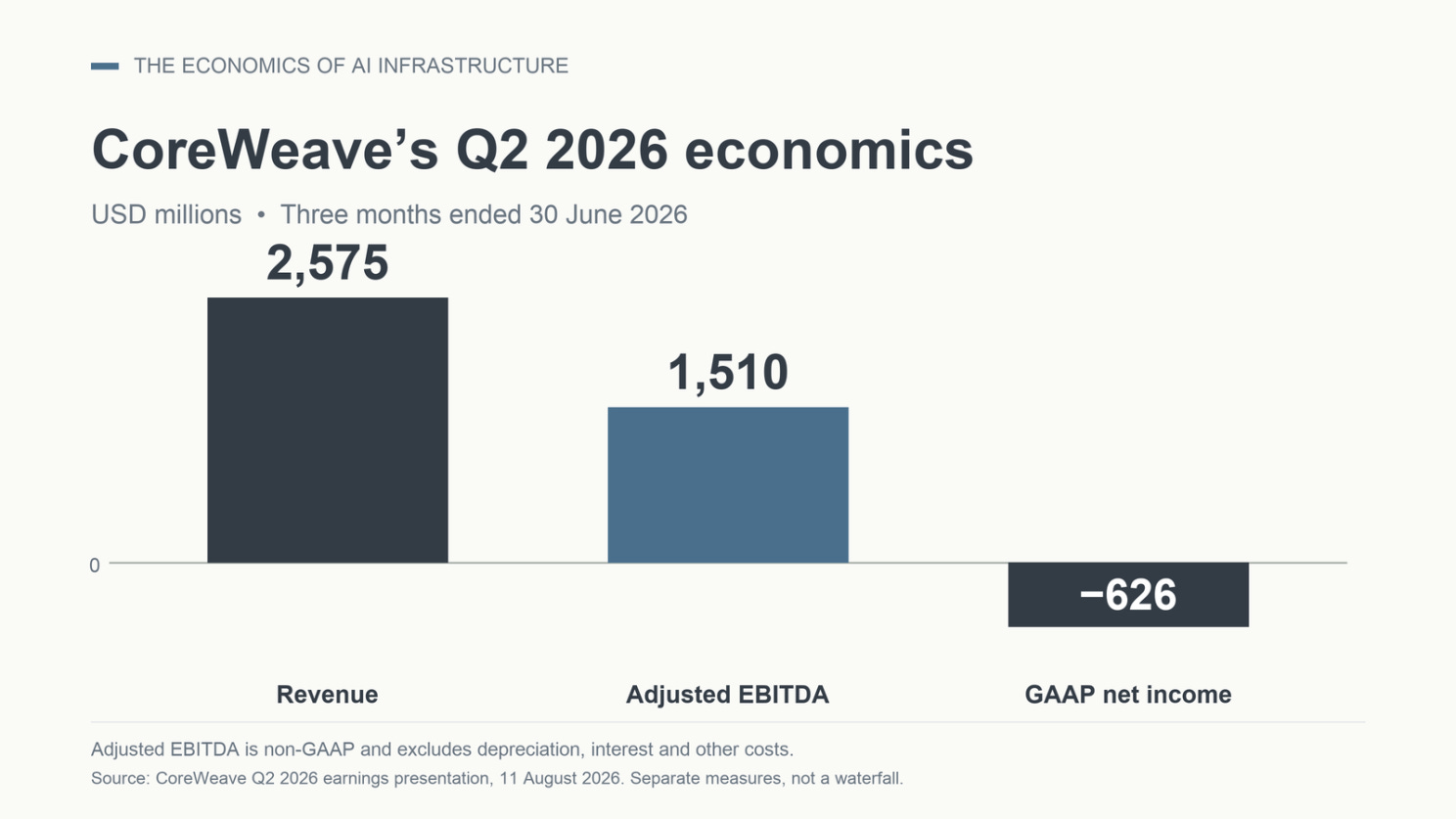
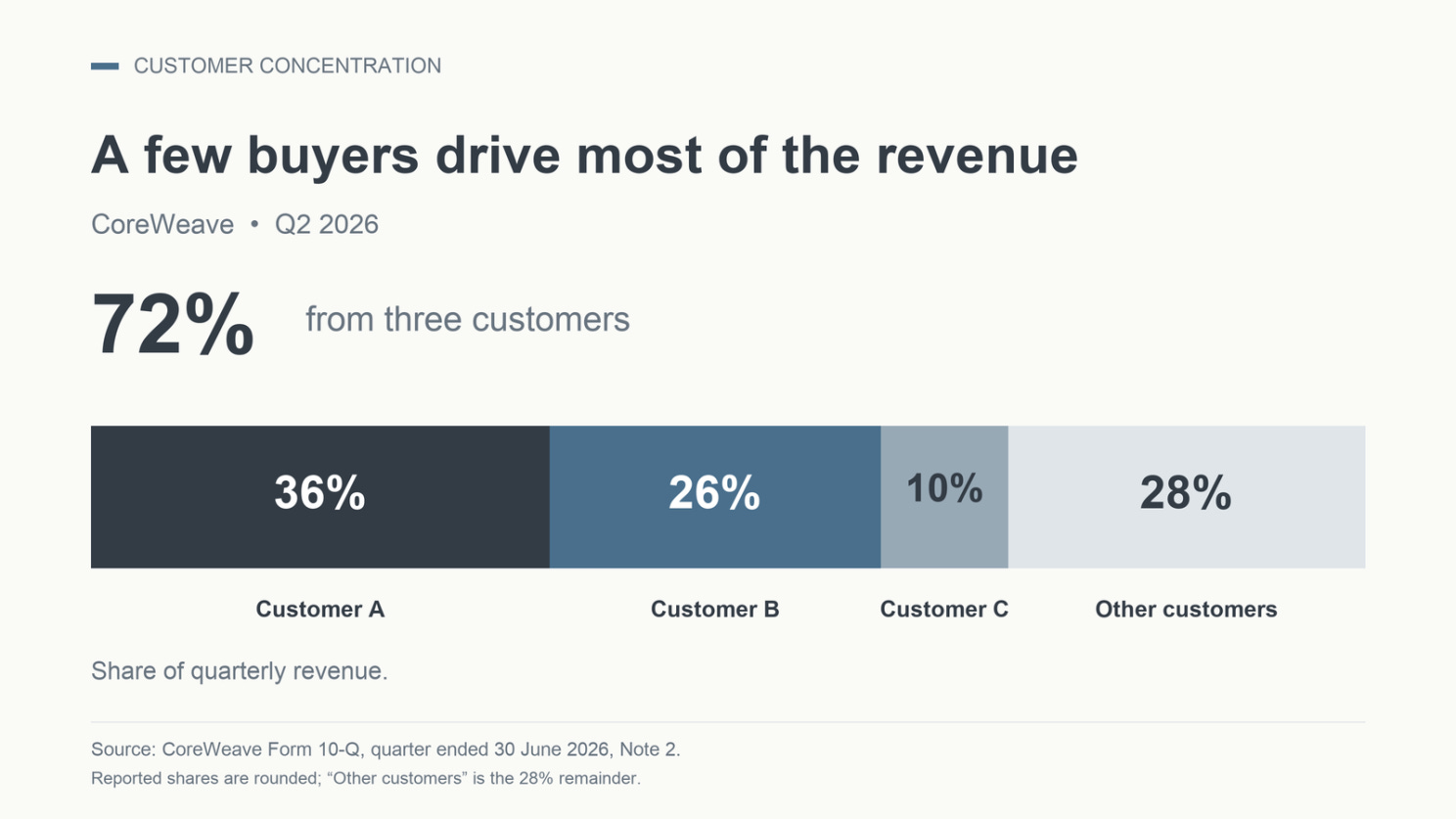
In the same quarter, operating cash flow was $679 million against $6.422 billion of cash purchases of property and equipment, including internal-use software. Three customers supplied 72% of quarterly revenue.
Delivery also depends on physical infrastructure. Reuters reported that Oracle issued a force-majeure notice over potential power delays at Project Jupiter; Oracle maintained its schedule and Blue Owl said financial commitments were unchanged.
I share Ed Zitron’s skepticism about the financing behind the AI boom. My view is that parts of this buildout are overvalued. For a software founder, the practical concern is dependence on a supplier, its prices, and its ability to deliver. Build the product so that improving models and falling inference costs strengthen the business. Keep enough flexibility to change suppliers when the economics demand it.
5. Own the work the customer keeps paying for
The business underneath the interface will matter more as impressive interfaces become easier to build. A general-purpose model can be available to every competitor. Knowledge of a customer’s rules, reliable connections to its systems, distribution, and a record of handling difficult cases take longer to acquire.
The large platforms are already competing for this position. Microsoft describes exposing hundreds of thousands of business actions to agents while retaining permissions and audit trails. An independent product needs a reason to be chosen alongside that reach: a process it understands better, a customer group it serves more effectively, or a result it delivers more reliably.
For a founder or PM, I would begin with an expensive task somebody repeats every week. Follow the work across the tools and decisions it requires. Find where people lose time, where errors create costs, and where approval is essential. Then measure whether the product can finish the job at a price customers will renew and a cost the business can sustain.
The market wanted software companies to sell the finished car. Agents offer another way to assemble it around the systems a customer already owns. The next software business will earn its place by taking that assembly off the customer’s hands. And making the whole thing work.